


OPINION
By Ian Pattison
This column has been updated with new information.
TELL ME if you’ve heard this one before.
A senior patient (OK, me) gets his annual (well it used to be annual, now it’s once every 18 months) eye exam and is told he’ll need cataract surgery. The procedure (a needle in the eyeball to remove the cataract and install a new lens) sounds awful but this is the most common surgery in Canada so it can’t be that bad. Fingers crossed.
Then comes the news that the referral – not the surgery – will take a year, and probably more. And since the patient has “clinically significant decreased vision that impacts their daily life” it’s all covered by OHIP. Well, except for something called OCT and Fundus photography during the examination which saw $85 go on the old Visa card.
In the meantime I was told I’ll need new glasses now, and another new pair after the surgery. When that time finally comes, OHIP covers standard cataract lenses, but ophthalmologists can offer upgraded lenses to eliminate the need for glasses – if patients pay additional fees. You can see where this is going.
Since this surgery is so common, why will it take so long? One would assume the Ontario health-care system would allocate all the necessary resources – ophthalmologists, nurses, operating room time – to meet the demand that is growing as the population ages.
Well, no.
“The Ontario auditor general reported there are under-used surgical spaces in Ontario hospitals that require nursing staff to operate,” wrote Tamara Daly, professor of health policy and equity at York University in The Conversation. “This is a human resources challenge, not a space challenge.”
Ontario’s private eye surgery clinics have for years been doing for-profit cosmetic and laser eye surgeries for people who pay directly for procedures. Last year, the Conservative government approved contracts for three laser eye businesses in southern Ontario to do cataract surgeries paid for by OHIP with plans to expand the program.
That’s good, right? Well, no.
Surgeries in for-profit clinics cost the public system more than if they were performed in non-profit hospitals – a fee of $605 per patient for a single-cataract surgery and $1,015 for a double versus a flat $500 for public hospitals. The extra fees multiplied by thousands of procedures would be far better used for desperately-needed improvements to public health:
– more hours of home care with personal support workers;
– more nurses to staff a hospital operating room;
– more primary-care teams to service the estimated two million residents without family doctors;
– more medical school spots;
– more residency spots for ophthalmology with more staff physician positions at teaching hospitals to do their training.
Ontario has only three ophthalmologists per 100,000 residents – hence my year-long wait. That ratio is made worse when ophthalmologists, whose education is significantly underwritten by public funds, work with a foot in both private and public systems.
The province could regulate how often ophthalmologists perform optional procedures to prioritize medically necessary surgeries that save people’s vision. Instead, it appears intent on expanding private health care (more private MRI and CT imaging, colonoscopies and endoscopies, hip and knee replacements are planned) at the growing expense of the public system, enriching friends of the PC party in the process.
WHO CAN FORGET the tragedy of COVID-19? The death toll was considerably higher in for-profit long-term care homes.
In December, 2020, UniversalCare Canada Inc. was put in charge of Etobicoke’s Westside Long-term Care Home where 27 residents had died of Covid due to under-staffing. UniversalCare’s CEO, Joseph Gulizia, has made multiple donations to the Ontario PCs since 2015, according to Press Progress.
It is reminiscent of Ford’s move to place ServiceOntario locations inside some Staples stores. Staples CEO has also been generous to Ford’s PCs.
Ford’s (then) assistant infrastructure minister is an outspoken defender of Ontario’s response to COVID-19 in long-term care homes. In 2021 Press Progress reported that Stephen Crawford, now associate minister of mines, appeared to hold shares in two high-profile private, for-profit LTC companies — Sienna and Chartwell, among the top private care companies linked to elevated resident deaths. Chartwell’s former CEO was former Tory premier Mike Harris.
IF THERE is one leading cause of unnatural death it is alcohol. Yet Ford is vastly increasing the availability of beer, wine and ready-to-drink cocktails by allowing sales in corner stores and even gas stations. It’s as if the deadly link between drinking and driving didn’t exist.
From Aug. 10 to 20, Thunder Bay police charged 10 people with impaired driving.
“Averaging one a day is not a real trend that we want to see,” said traffic Const. Tom Armstrong. “They’re coming weekday, weekend, daytime, afternoon, night — it doesn’t really seem to matter. It’s a very concerning trend . . . “
“People are going to drink more and there’s going to be more emergency room visits, deaths, chronic health conditions and acute health problems and social problems,” said Dr. Daniel Myran, who has studied the costs of previous changes to alcohol sales, including grocery stores.
Research shows that in 2020 alcohol was estimated to cause 6,201 Ontario deaths and led to about 47,500 hospital admissions and 258,700 emergency department visits.
AS IF all of this doesn’t put enough stress on the public health system, the Financial Accountability Office of Ontario (FAO) issued a report in 2023 revealing that hospital capacity will considerably diminish by 2027-2028 due to surging demand and that the province is allocating over $21 billion less to the sector.
The report documents that Ford’s government will fail to fund current health sector programs and deliver on its program expansion commitments in hospitals, home care and long-term care. Meanwhile, the health system is trying to manage a shortage of nurses and personal support workers — a deficit that the FAO projects to persist through its six-year forecast period.
The province announced on Friday it will transfer $14,782,300 to the Thunder Bay Regional Health Sciences Centre this year, an operating increase of 5.6 per cent.
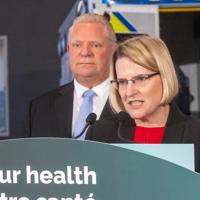
“Our government is continuing to make record investments in our publicly-funded health-care system to connect families across the province to the care they need, when they need it,” said Health Minister Sylvia Jones in a statement. “This unprecedented investment in our hospitals will ensure they can continue to deliver high-quality care while reducing wait lists and wait times in their communities, for years to come.”
Let us hope so while waiting to see if that happens in a hospital perpetually at or near capacity, with one of Canada’s busiest emergency departments seeing some 9,000 visits a month and climbing.
Tellingly, perhaps, hospital president and CEO Rhonda Crocker Ellacott said she is “grateful for this increase in base funding that will allow us to address some (emphasis added) of our operational challenges . . .”
In a separate announcement, the government announced that it is spending $33,868 this year to upgrade and repair infrastructure at the regional hospital. That should barely cover repairs to walls damaged by moving stretchers that was the subject of a recent letter to this newspaper.
Last year, the Ontario Union of Family Physicians called for the resignation of Health Minister Sylvia Jones who denied the worsening crisis in family medicine. Her comments that “there is no concern of a diminished supply of physicians” and that “retention and recruitment is not a major concern” is “a slap in the face to Ontarians, particularly to the 2.3 million who do not have access to a family doctor and for those who have recently or will soon lose their family doctor due to inadequate funding and increasing administrative burden,” said the OCFP which projects that by the year 2026 one in four Ontarians will not have a family doctor.
Jane Philpot, the former federal health minister who was a family physician for years before first seeking office, said this week she may consider a return to politics and is said by some to be considering a run for the Liberal leadership if Justin Trudeau calls it quits. Philpot’s new book, Health For All, is a sensible, detailed prescription to address the family doctor shortage and much else that is wrong with Canadian health care.
It’s been said that our health systems are a reflection of what we want and who we elect – something to bear in mind at both the coming federal and Ontario elections.
Ian Pattison is retired as editorial page editor of The Chronicle-Journal, but still shares his thoughts on current affairs. You can email him at iPatPoint29@gmail.com.
link