

Funding suspensions and cuts at the National Institutes of Health, the global powerhouse of medical research, have introduced chaos into a field that thrives on stability.
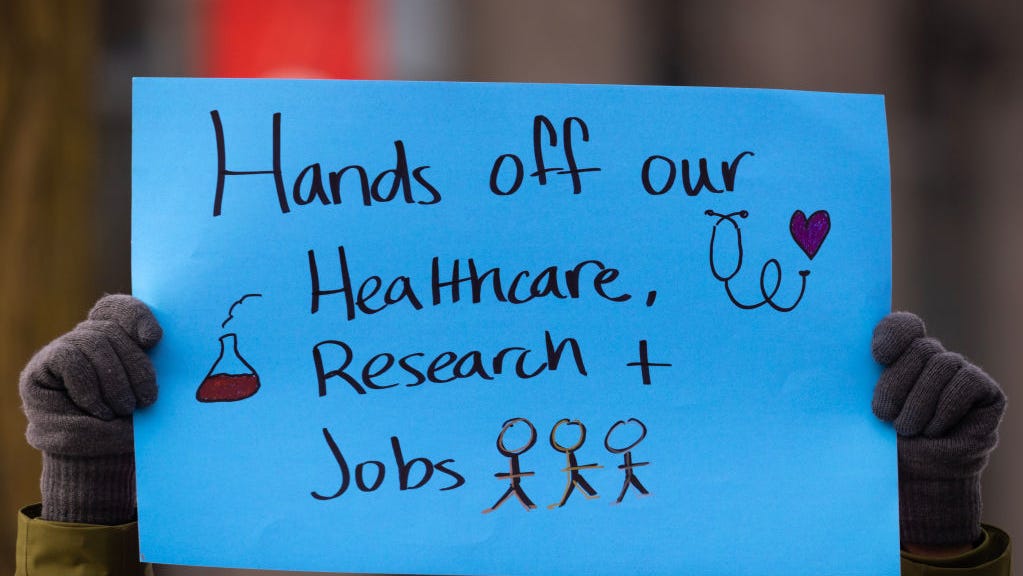

Protesters against planned National Institutes of Health funding cuts
The Trump administration’s push to slash funding at the National Institutes of Health has been temporarily blocked by a federal judge.
If not for years of brain research, I would be living in unending, unremitting pain. My head would be twisted to one side, and I’d cope as best I could with a diet of old-timey muscle relaxants and painkillers. Some muscles would atrophy, while others would become abnormally large.
But brain research permits me to live with my cervical dystonia, a relatively rare brain condition, with no pain. The research resulted in a treatment – Botox injections in muscles that my brain is ordering to contract – that has few serious side effects.
I can concentrate. I kayak, bike, lift weights. I can do anything I want. A year ago, I freeclimbed up a sheer rock face.
Brain conditions run the gamut from migraines to multiple sclerosis, from dementia to dyslexia. Dealing with brain conditions is close to a universal experience. About 43% of all people will experience one, so odds are that if you don’t have one, a loved one will. That makes it imperative to do two things.
Ways to protect against brain injury and disease
The first is to take steps that enhance your chances of keeping your own brain healthy and durable. These steps include:
- Keep your vaccinations current – some preventable diseases can lead to brain conditions, including COVID-19.
- Take even small steps to limit exposure to pollution and toxins – some are linked to Parkinson’s and other degenerative diseases.
- Protect your head – traumatic brain injury is one of the most preventable, yet devastating, risks to long-term brain health.
- Take care of your mental and emotional well-being – doing so can lower your risk of dementia.
The second is to support brain research, however you can, and resist efforts to undermine or stop it. I say this not only as a person with a brain condition, but in my role as executive director of the American Brain Foundation, which supports a network of scientists working to unlock breakthroughs in whole-brain health, in the belief that curing one condition will cure many others.
Funding cuts make progress more difficult
We’re doing our part, but you may have noticed that these are difficult times for medical research.
Funding suspensions and cuts at the National Institutes of Health, the global powerhouse of medical research, have introduced chaos into a field that thrives on stability.
Cutbacks to research mean thousands of real patients are losing their chance at treatments, and millions more will have hope of a cure or treatment delayed or quashed entirely.
Researchers right now are learning about how to detect dementia earlier, which will lead to further work that uncovers how the disease works. Dozens of scientists are studying neuroinflammation, a symptom common to a wide variety of brain conditions as diverse as autism, long COVID, multiple sclerosis, Alzheimer’s and more.
Figuring out how to address neuroinflammation could unlock a world of cures and treatments. This is a terrible time to walk away from that work.
Congress also has a role, if it wants it. Urge senators and representatives to reassert their role, fully fund medical research, and insist the administration makes use of that funding.
Every treatment we have has been the result of research. The ibuprofen you take for your headache, the concussion protocols for your soccer-playing child, and more have all moved from labs into our lives.
I have my own unfortunate experience of what the lack of treatment looks like. When my dad had multiple sclerosis, treatments were quite limited. The disease broke down the connection between his brain and his body, leaving him numb, weak and increasingly immobile.
Thanks to decades of well-funded research, my dad would have had a different outcome today. People get the disease into remission and live happier, more functional lives. We can make a difference.
Fortunately, there are steps any American can take. Everybody can assist in funding more research, even with as little as $20. Organizations like the American Brain Foundation and others devoted to specific brain conditions put that money to good and efficient use. Every dollar gets us a step closer to cures.
Michelle Heritage is executive director of the American Brain Foundation, which funds research on the full spectrum of brain conditions.
link