
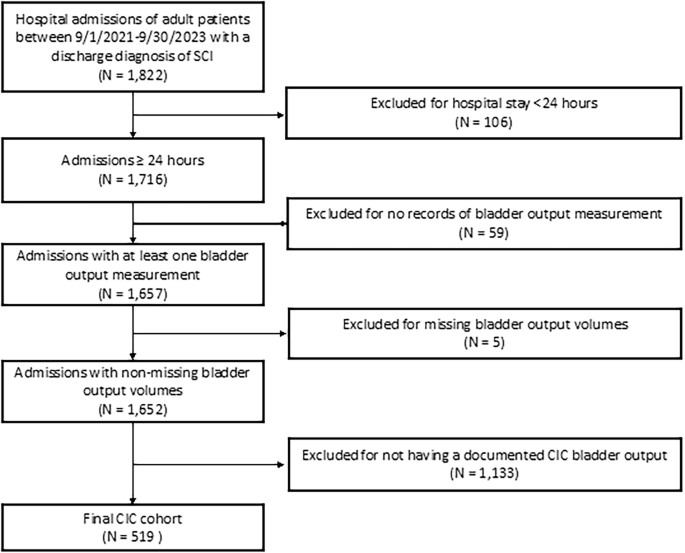
This was a retrospective cohort study examining guideline-discordant CIC among patients with SCI hospitalized within a large, academic healthcare system. The study included all admissions between September 1, 2021 to September 30, 2023, across five acute care hospitals located in diverse demographic regions (three urban and two mid-size area). Patients were eligible for study inclusion if the following criteria were met: (1) ≥ 18 years of age; (2) a discharge diagnosis of SCI; and (3) at least one documented CIC bladder output volume during the hospital admission. A SCI discharge diagnosis was identified using International Classification of Diseases 10th revision (ICD-10) diagnosis codes (Supplement Table S1). Patients were excluded if they had a hospital stay <24 h or died during hospitalization. The University of Pennsylvania Institutional Review Board approved this study with a waiver for informed consent due to the retrospective design.
Data sources and cohort
Data was extracted from electronic health records (EHR) using the Epic Clarity database. Epic Clarity stores both patient demographic and clinical data. Demographic information included age, sex, race, ethnicity, and insurance type at admission. Clinical data elements, such as discharge diagnoses, were extracted for each eligible admission. To obtain CIC-associated bladder output volumes, both medical orders and flowsheet data were extracted. Specifically, patient bladder output type (e.g., CIC or IUC), volume, and timestamp were identified by using output labels in the flowsheet data (Supplemental Table S2). For example, if a bladder output was labeled as “intermittent/straight cath (mL)”, it was classified as a CIC occurrence.
For bladder output measurements with non-specific labels, such as “urine output”, we referenced the clinician medical order file to determine if a bladder output was from CIC (Supplemental Table S2). For example, if there was an active medical order for straight catheterization at the time of the recorded non-specific bladder output, the bladder output volume was re-classified as CIC-associated. Similarly, if there was an active medical order for insertion or maintenance of IUC, the non-specific bladder output volume was re-classified as IUC-associated. The IUC-associated bladder output records were retained in order to calculate the duration of IUC use prior to the initiation of CIC, which was examined as a predictor for guideline-discordant CIC. In the case where both CIC and IUC orders were active, we used the order placed closest in time to the bladder output measurement. If none of the CIC and IUC related orders were active, the bladder output volume was kept as a non-specific urine output, not associated with either CIC or IUC, and excluded from this analysis.
Outcome assessment
The primary outcome was guideline-discordant CIC management. Guideline discordance was defined as a CIC-associated bladder output volume >500 mL and/or a time interval between CIC occurrences >6 h [5, 6]. Using these criteria, each CIC occurrence was labeled as either guideline-discordant or guideline-concordant.
We calculated the time interval between consecutive CIC occurrences by using the timestamps of CIC-associated bladder output volumes that were recorded during the same admission. The time intervals between CICs were capped at 24 h, as CIC is typically completed multiple times a day. A set of CIC measurements where each measurement was less than 24 h from the prior one was considered a continuous bladder management sequence and defined as a “CIC stretch”. By capping at 24 h, we calculated time intervals between consecutive CICs within the same CIC stretch, but not ones from different CIC stretches, to account for medical teams trialing different bladder management methods during the admission. In the scenario where there was only one CIC recorded during the admission, CIC intervals could not be calculated, and thus guideline discordance was assessed solely based on the bladder output volume.
The secondary outcome was UTI. A UTI case was identified using a combination of ICD-10 diagnosis codes (Supplement Table S3), abnormal urine culture, and administration of antibiotics (cefpodoxime, trimethoprim/sulfamethoxazole, levofloxacin, or cefepime) [20, 21]. The administration time of antibiotics was required to be during the urine culture collection time window plus 24 h. If a patient met the definition of UTI at any point during the admission, they were classified as a UTI case. When multiple UTI events were identified during the same admission, we used the first event in the analysis, meaning each patient admission was allowed to have up to one UTI event.
Statistical analyses
Patient characteristics at admission and descriptive analyses of guideline-discordant CIC management were summarized by mean (standard deviation, SD) or median (interquartile range, IQR) for continuous variables and by count and percentages for categorical variables.
To examine factors associated with guideline-discordant CIC management, we fit a generalized linear model with nested random effects for admission and patient to adjust for correlation of CIC recordings within the same admission and patient. The patient factors included age, sex, race, and insurance type at admission. Clinical factors included level of spinal cord injury (cervical versus thoracolumbar level), duration (in days) of IUC prior to CIC, time of day when CIC was completed (daytime = 7am-7pm, or nighttime = 7pm-7am). Additionally, the model adjusted for intravenous fluid infusion that overlapped with or stopped within 24 h before CIC occurrence, as this may increase bladder output volume and lead to a higher chance of guideline-discordant CIC. Beta coefficients from the model were exponentiated to obtain odds ratios (OR) and 95% confidence intervals (CI).
Differences in UTI incidence by guideline-discordant status were examined using a Chi-square test. Because the incidence of UTI was assessed only once during an admission and CICs could occur multiple times during the same hospitalization, we created a variable for guideline discordance at the admission level. An admission was classified as having guideline-discordant CIC if the median bladder output volume, across all recorded outputs, was >500 mL and/or the median time between CIC sessions, across all CIC sessions, was >6 h during the admission. All analyses were implemented using SAS statistical software version 9.4.
link