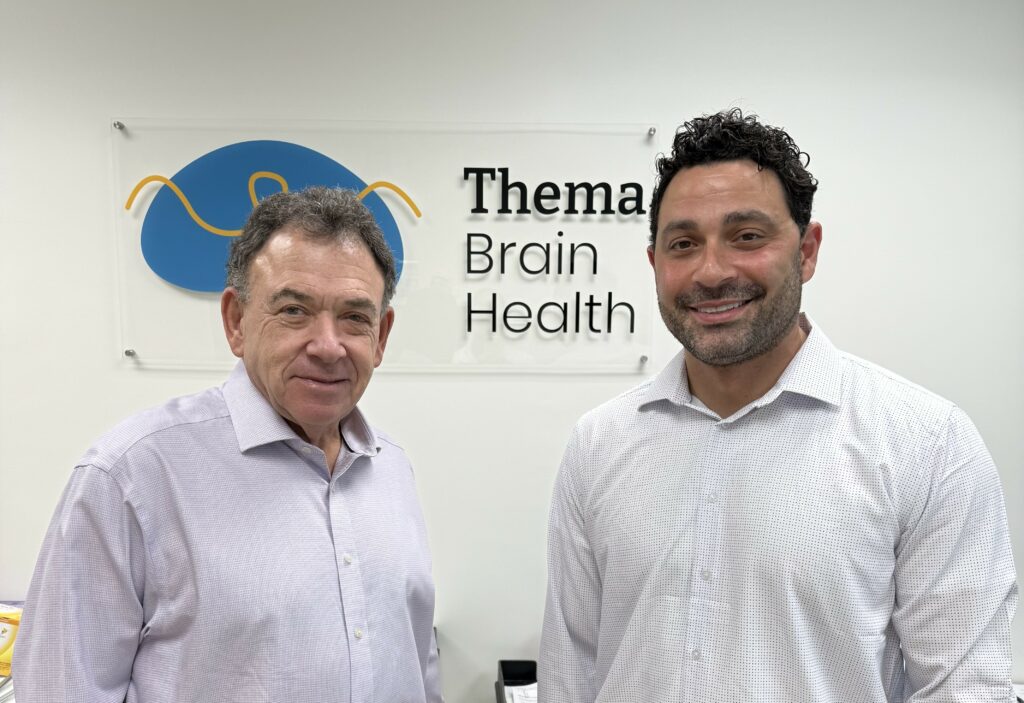
Why not, say the founders of Thema Brain Health, treat neurodegenerative issues the same way we’ve come to treat heart disease – with prevention and early intervention key to healthier brains? That may be the most effective way of addressing the increasing rates of Alzheimer’s and other dementias, according to Thema co-founders, Dr. Robert Colton, chairman, and Seth Harlem, CEO.
The approach of Thema, located at the Research Park at Florida Atlantic University, is to identify problems early on, then advise and prescribe a variety of targeted treatments. What may be just as crucial, company strategy calls for scheduling appointments within a week or two, bypassing what can be a months’ long wait to book an appointment with a standard neurology practice.
The approach lets in light and air to a problem often kept under wraps. “People are still ashamed of cognitive decline; It’s sad and scary,” said Colton, adding that fears of losing independence and ending up in a nursing home are common.
And help can’t come soon enough. About 7 million Americans currently have Alzheimer’s, and that is expected to grow as more people reach their 80s and 90s. Meanwhile, Parkinson’s disease is being diagnosed at 90,000 per year, according to the Parkinson’s Foundation. It is estimated that 1.2 million people will have the disease by 2030. Thema also treats a variety of other conditions, including ALS and myasthenia gravis, among others.
Typically, people seek out a neurologist when symptoms become obvious, or, because concern about forgetting grandma’s ravioli recipe might auger a serious problem. Until recently, explained Colton, the only definitive way to diagnose Alzheimer’s was by examining the brain after a person died, where characteristic plaques and tangles are seen. But now it can be diagnosed with a blood test followed by a PET (positron emission tomography) scan and steps can be taken to address the condition (Other dementias have their own diagnostic criteria).
New research has made treatment – especially early on – a meaningful possibility. First, explained Colton, it’s important to understand that a healthy lifestyle can significantly impact dementia onset and progression. That includes following some form of the Mediterranean diet, exercise, good sleep habits and keeping the mind engaged. Yet most important is controlling cholesterol and high blood pressure. “Treating hypertension is more important than anything else,” he said. Reasons are unclear, but keeping cholesterol and blood pressure in check can reduce dementia incidence by up to 30 percent, Colton said.
Meanwhile, a new family of drugs, such as Lecanemab are showing great promise. These drugs are able to cross the blood-brain barrier and lower the amount of the amyloid plaques that are an Alzheimer’s hallmark, explained Colton.
Colton spent his career as a primary care and internal medicine doctor, built up and sold a concierge practice, then, with his wife Dr. Andrea Colton, a dermatologist, started ClearlyDerm, with five locations. It is now part of the Schweiger Dermatology Group. Still, Colton knew he had more to contribute. “I wanted to do something exciting, and what would make the most contribution,” he said. He focused on the diseases of aging, then narrowed in on cognitive decline. That is in part because the need is urgent and ongoing research is exciting. He joined with his son-in-law, Harlem, whose background includes co-founding biotech company, Taithera. A third co-founder, Sam Lehr, chief strategy officer, a lawyer and founder of Muchomas Chocolate, joined as well. The company, which was established in its current form in 2024, now has 18 employees. Thema has raised about $3 million and has one outside investor.
Direct outreach is part of its business model. Those interested can request an appointment online, usually scheduled within a week or two. The firm is now associated with Boca Raton Neurologic Associates and Dr. Lorin Graef, the first of what it hopes to be many neurology practices. “We want to make it easier to get into see us,” Colton said.
Once at the office, the patient takes a test and is evaluated by highly trained ancillary personnel, which takes about a half hour, before seeing the doctor. The idea is to institute a more efficient streamlined process, allowing the neurologist to see more patients – which also translates to increased revenue.
“Neurology as a specialty of treating illnesses after symptoms develop, that is changing, Harlem said. “Neurology needs to become a specialty of prevention.”
An integrated approach includes both lifestyle guidance and the new medications, if appropriate. The drugs work best for people in the earliest stage of Alzheimer’s. To qualify, patients must have cognitive decline with the presence of amyloid plaques. Harlem underscored that guidelines don’t currently recommend measuring biomarkers in those with normal brain function, except in research settings.
There is still much to learn about Alzheimer’s and other dementias. For example, not all those who have plaques and tangles or Alzheimer’s biomarkers have cognitive issues. Why is unclear. Still, research, new drugs and AI input pretty much guarantee expansion of the treatment field.
Thema’s plan is to roll out the process with more neurology practices as the company works to educate people, especially those in their 60s and beyond, about the prevention approach to brain health. The “worried well” – those without risk factors – should have a yearly examination. For those with some risk factors, such as high blood pressure, genetics or other issues the goal is to intervene before symptoms emerge.
“Thema’s biggest challenge is to get patients to seek evaluation when symptoms are mild,” Harlem said. “This is when the current disease modifying therapies (including the new group of drugs) are most effective.”
Pictured at the top of this post: Thema Chairman Dr. Robert Colton and CEO Seth Harlem.
READ MORE IN REFRESH MIAMI:

I’m a South Florida business writer, with wide experience covering everything from tech startups to established public companies. I’m most intrigued by entrepreneurs who adapt technology to the needs of our world in a creative manner, such as for nature, medicine or underserved communities.
link