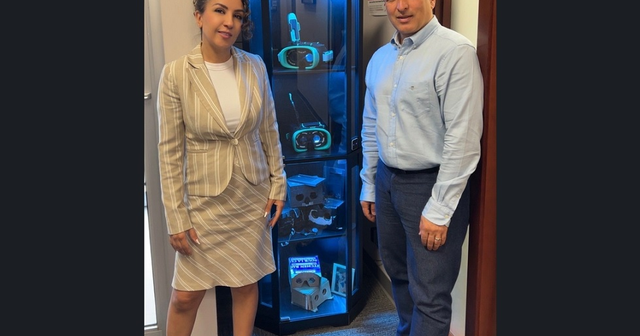
In a field as complex as neurology, groundbreaking solutions rarely start with cardboard and mirrors. However, for Dr. Neda Anssari and Dr. Behzad Mansouri — a pair of Winnipeg-based neurologists, married co-founders of Neuroptek, and co-inventors of a medical device called Eye Mirage — their quest to reshape vision and concussion care began in the most unassuming of places: Their garden.
“We were working on ideas while gardening one summer afternoon,” said Dr. Mansouri. “Just one idea after another, until suddenly we said — this might work.”
That spark of inspiration, fuelled by years of experience treating patients with concussions and neurological eye conditions, has since evolved into a patented medical device undergoing clinical trials in Winnipeg. The goal: To give clinicians, athletic trainers, and even frontline workers in remote communities a fast, affordable, portable way to assess vision and diagnose concussions — right from a smartphone.
And they’re building it all from right here in Manitoba.
Dr. Anssari and Dr. Mansouri run a busy private clinic in Winnipeg that focuses on comprehensive concussion and eye-related neurological care. Between them, they carry specializations in neurology, neuro-ophthalmology, and neuroscience. Their clinic, which also includes an optometrist on staff, is believed to be one of the only facilities in Canada offering this level of integrated concussion and visual diagnostics under one roof.
“We see a high volume of patients dealing with headaches, vision problems, and concussion symptoms,” said Dr. Anssari, who also serves as Medical Director of the clinic. “But one of the biggest challenges we face is the lack of objective, accessible tools for diagnosis — especially for concussions.”
That diagnostic gap, especially in remote and underserved regions, is what drove the couple to pursue a long-held idea: A device that could collect precise visual data using a smartphone — capturing everything from eye movement to acuity to colour vision — without requiring bulky machines or in-person exams at specialized centres.
The idea behind Eye Mirage is deceptively simple: Use the power of today’s smartphone cameras and displays to run essential vision tests. The execution, however, required years of research, experimentation, and innovation.
After that eureka moment in the garden, the couple rushed inside and fashioned their first prototype using cardboard and mirrors from Home Depot.
“It was primitive, but it worked,” Dr. Mansouri recalled with a smile. “We proved we could show two different images to two eyes using a smartphone — something no one had done successfully before.”
From there, the couple refined their concept through 3D-printed models, clinical collaboration, and eventually, professional design. Eye Mirage was born.
The device holds two smartphones, carefully aligned with transparent mirrors placed at 45-degree angles. This configuration allows one phone to display images while the other captures eye movement and function in real time. Artificial intelligence then processes the video, providing instant diagnostic feedback that can be shared securely with healthcare providers via cloud or electronic medical records.
“With just this device and two smartphones, we can assess visual acuity, colour vision, eye movement — even detect signs of lazy eye or glaucoma,” said Dr. Anssari. “And it’s portable enough to be used anywhere — in clinics, waiting rooms, schools, even at the side of a sports field.”
One of Eye Mirage’s most promising applications is in the world of sport.
Concussions — especially those experienced during contact sports — are often underdiagnosed or missed altogether. A second concussion before the first one heals can be fatal, particularly for young athletes.
“This is where Eye Mirage can make a life-saving difference,” said Dr. Mansouri. “Athletic teams can screen their players at the start of the season, then use the device to reassess after a head impact. If results differ, that’s valuable data for team doctors to decide whether a player should be pulled from the game.”
Unlike traditional concussion assessments, which rely heavily on symptom reporting and subjective interpretation, Eye Mirage offers objective evidence of neurological impairment — and does so in seconds.
“This is information that could save someone’s life,” said Dr. Anssari.
Beyond the sports world, Eye Mirage has the potential to ease the burden on Canada’s overtaxed healthcare system, especially in rural and northern communities.
“We know how difficult it is for patients in remote areas to access specialists,” said Dr. Mansouri. “In many cases, people are flown to Winnipeg by air ambulance just to be assessed. That’s expensive and unnecessary if the right tools were available locally.”
With Eye Mirage, a nurse or frontline provider in a northern clinic could test a patient on-site and transmit the results to a specialist in real time — avoiding needless transfers while expediting urgent care.
“We want this to be part of the solution that reduces wait times, lowers costs, and gives patients faster, better answers,” said Dr. Anssari. “It’s a tool that empowers both patients and practitioners.”
The Eye Mirage project has already completed its preclinical trial involving 24 patients. A randomized, double-blind clinical trial involving 160 patients is currently underway across four Winnipeg clinics — and is already 40% complete.
Neuroptek recently secured a Health Canada Investigational Testing Authorization (ITA) for Eye Mirage and is now working toward full medical device certification. They’ve passed their first ISO and Medical Device Single Audit Program (MDSAP) audit, and their second is scheduled for later this month.
They’ve also chosen a Canadian manufacturer to produce the devices, after vetting firms in both the U.S. and Canada.
“We’re proud to be building this right here in Manitoba,” said Dr. Mansouri. “This started in our home, in our city, and we believe we can make a global impact from here.”
While their current clinical trials focus on Canada, Drs, Anssari and Mansouri are already thinking globally.
They’ve established connections with medical communities in Japan and Hong Kong and plan to expand to the U.S. and Europe following Health Canada and FDA approval.
“In some countries, there are simply no specialists available to assess neurological or eye conditions,” said Dr. Anssari. “With Eye Mirage, those communities could test patients and send the results to experts anywhere in the world — bridging gaps in care that were once impossible to close.”
Their ultimate hope? That no one in Canada — or anywhere — goes blind or suffers neurological damage because of delayed diagnosis.
“Diseases like glaucoma and lazy eye are preventable if caught early,” said Dr. Mansouri. “This device can help make that possible for everyone, regardless of where they live.”
“We’re incredibly proud that Neuroptek was born in Winnipeg,” said Dr. Mansouri. “We started in Manitoba, we started in Canada — and now we hope to bring something truly impactful to the world. This company proves that innovation doesn’t have to come from a major hub.”
“Even in a smaller entrepreneurial community like ours, there’s tremendous potential. We believe Winnipeg can be a leader in technology, in medicine, and in shaping what’s next for global healthcare.”
— Pam Fedack is a Local Journalism Initiative reporter who works out of the Winnipeg Sun. The Local Journalism Initiative is funded by the Government of Canada.
Have thoughts on what’s going on in Winnipeg, Manitoba, Canada, or across the world? Send us a letter to the editor at [email protected].
link