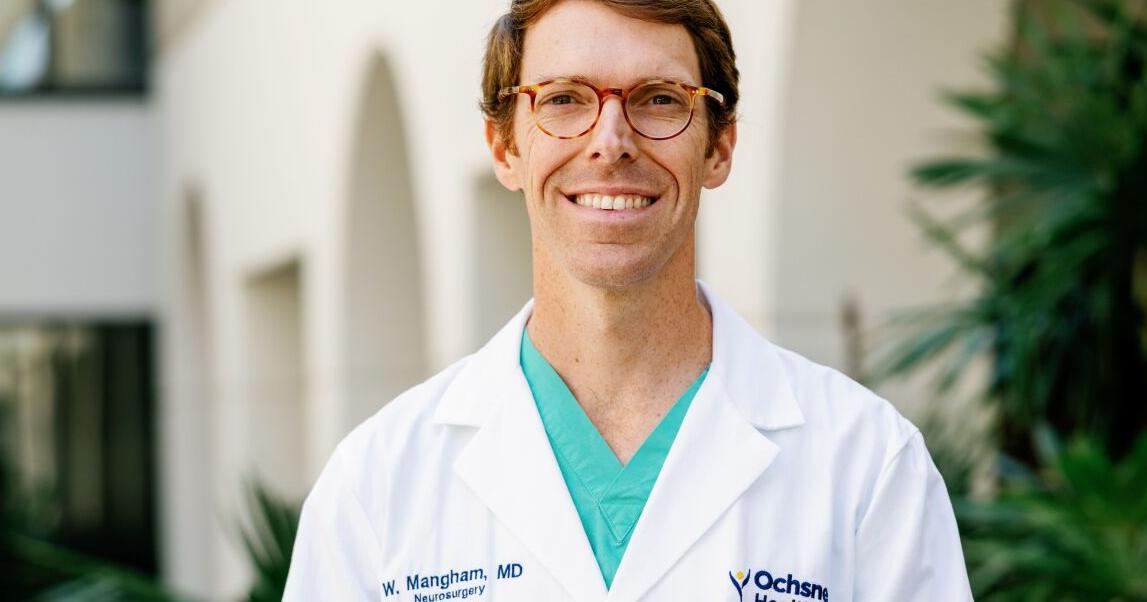
At Ochsner Health, patients with certain back and spine problems who meet specific criteria may now be candidates for one of the nation’s most promising innovations in spine care: ultra-minimally invasive endoscopic spine surgery, performed by neurosurgeon William Mangham, MD.
Dr. Mangham, who practices with Ochsner’s nationally ranked Back and Spine program, is one of only three surgeons in the New Orleans region and one of two at Ochsner currently offering this specialized procedure. Using state-of-the-art equipment and an incision that measures less than one centimeter long, the technique allows surgeons to remove herniated discs and relieve nerve pain with much less impact to nearby tissue and bone than is necessary in traditional back surgery. For patients, that means less pain, faster recovery and a quicker return to normal life.
“Because the camera used in this procedure is so small, there is a decreased risk of tissue and muscle injury. All surgeries have some degree of risk, but that level is as low as it gets when you use a spine endoscope,” Dr. Mangham said. “Anytime you can relieve a patient’s pain with minimal side effects, you could see them have improved outcomes.”
Back pain is one of the most common medical challenges in the United States, affecting roughly 80 percent of adults at some point in their lives. While most discomfort resolves on its own or with the help of medication, some people experience pain so severe that it disrupts their daily life, limits mobility and requires advanced treatment.
Among painful back and spine conditions, herniated discs are one of the most common problems treated by surgeons. Dr. Mangham described a healthy disc as a jelly-filled cushion between the vertebrae, absorbing shock and providing flexibility. When a disc herniates, he said, that jelly-like material presses onto nearby nerves, often causing sharp pain that radiates down one or both legs, or severe localized back pain.
“Any of those symptoms usually kicks off an investigation with MRIs and other imaging,” Dr. Mangham said. “It does not mean we go straight to surgery. Most patients improve with medication and physical therapy. We may try steroid injections. The fact that we can use an endoscope does not replace the conservative approach that we take. No one wants to undergo surgery unless they absolutely have to.”
However, for patients for whom surgery is the best option, Dr. Mangham said traditional approaches are effective but involve larger incisions, more muscle disruption and longer recovery times. Minimally invasive surgery that uses a two-centimeter incision has reduced many of those burdens and has become more common, but the new ultra-minimally invasive endoscope approach used by Dr. Mangham takes things even further.
“A two-centimeter incision is still quite small, but in that method, surgeons use metal dilators to pass through the muscle to get to the bone, then work their way to the nerves by drilling away the bone. That can cause more risk of muscle spasms and pain after surgery,” Dr. Mangham said. “With the ultra-minimally invasive endoscope, there is less inflamed tissue. The high-definition camera is about the width of a finger, and can now reach disc herniations through a very tiny incision in the skin. There’s much less disruption overall.”

Ochsner Medical Complex – Clearview offers a wide range of healthcare services, including advanced procedures such as ultra-minimally invasive endoscopic spine surgery, plastics, reconstruction surgery and much more.
For Dr. Mangham, being at the forefront of the latest in spine surgical technology is the latest step in a lifetime devoted to helping others. He was inspired to serve his country after the Sept. 11, 2001, terrorist attacks. A 2004 graduate of the U.S. Naval Academy, Dr. Mangham became a Marine Corps officer, leading troops in three combat deployments to Iraq and Afghanistan. Over a five-year period, he ultimately commanded a unit of 250 Marines before being honorably discharged as a captain.
After his military service, he pursued medicine at Brown University, followed by residency and fellowship training in spine surgery at the Semmes-Murphey Clinic and the University of Tennessee.
“Neurosurgery has always been such an interesting area to me because you work with both the brain and the spine. You get to help people who are experiencing extreme events that really impact their lives. I’ve always found that those are opportunities to connect with patients in meaningful ways,” he said. “We see a variety of neck and back issues, and some folks are in tremendous pain. This work lets me help people when they really need it. I find that incredibly rewarding.”
Now at Ochsner, Dr. Mangham sees patients at Ochsner Health Center – West Bank in Gretna and performs most procedures, including the ultra-minimally invasive endoscopic surgeries, at Ochsner Medical Complex – Clearview in Metairie. These operations are done in an outpatient setting, and patients are able to return home the same day due to the minimal pain and blood loss. A full recovery usually takes several weeks, although Dr. Mangham said most people see improvements almost immediately after surgery.
“You do have to be smart about recovery. Some people feel good and try to do too much, too soon,” Dr. Mangham said. “It’s fine to walk around, go up and down stairs and do light activities. I usually caution them to wait to do any heavy lifting or anything that involves bending or twisting, since that puts a lot of stress on the spine while things are still healing.”
While Dr. Mangham currently uses the ultra-minimally invasive endoscope to treat disc herniations, there are additional applications for more complex spinal conditions, such as arthritis, spinal stenosis and thoracic disc herniations that occur close to the spinal cord.
Dr. Mangham said these applications will expand with the endoscope’s use and continued training.
“I think the endoscope is an important part of the future of spine surgery,” he said. “There is more demand for this, especially as the number of applications grows. You’ll see more surgeons adopt these procedures as time goes on.”
Ochsner Health is the leading nonprofit healthcare provider in the Gulf South, delivering expert care at its 47 hospitals and more than 370 health and urgent care centers. To learn more about how Ochsner empowers people to get well and stay well, visit ochsner.org. To schedule an appointment, visit ochsner.org/schedule.
link